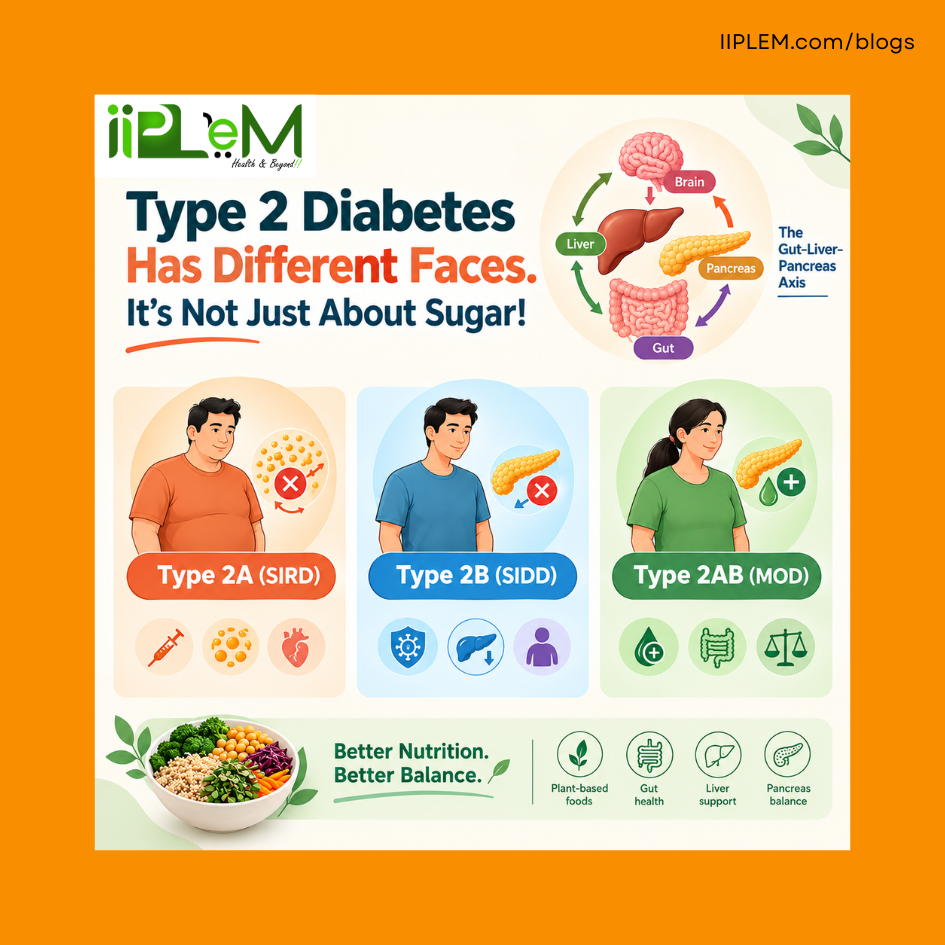
Why “Type 2 Diabetes” may be too simple—and why the food you eat can influence far more than your blood glucose
For years, many people have been told a simple story:
“You have Type 2 Diabetes because your sugar is high. Eat less sugar, take your medicines and control your HbA1c.”
That advice is not wrong.
But it may be incomplete.
Modern diabetes research is increasingly showing that Type 2 Diabetes is not one uniform biological condition. Different people can arrive at the same diagnosis through very different combinations of insulin resistance, declining insulin production, obesity, liver dysfunction and metabolic changes.
A recent Lancet Diabetes & Endocrinology perspective, PMID 40953573, takes this heterogeneity a step further by proposing a clinically oriented framework of Type 2 diabetes subtypes. (PubMed)
And there is an important message here for Indians:
The person with diabetes matters—not just the glucose number.
________________________________________
The three metabolic personalities of Type 2 Diabetes
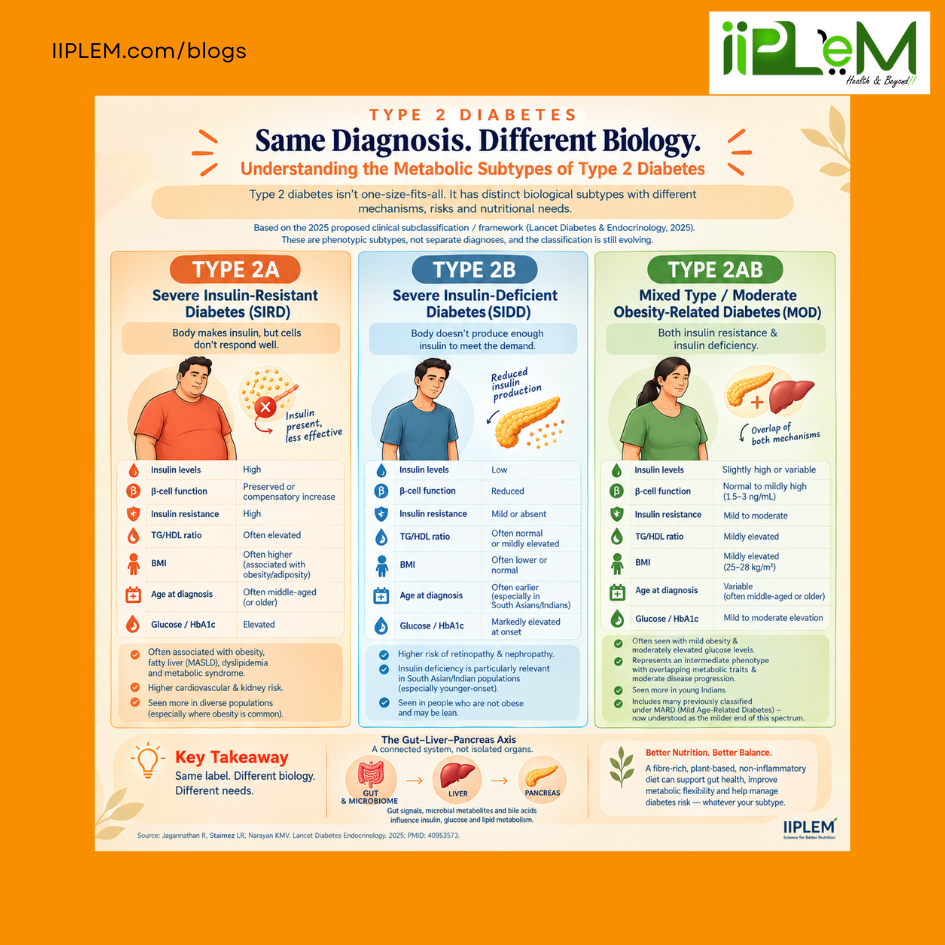
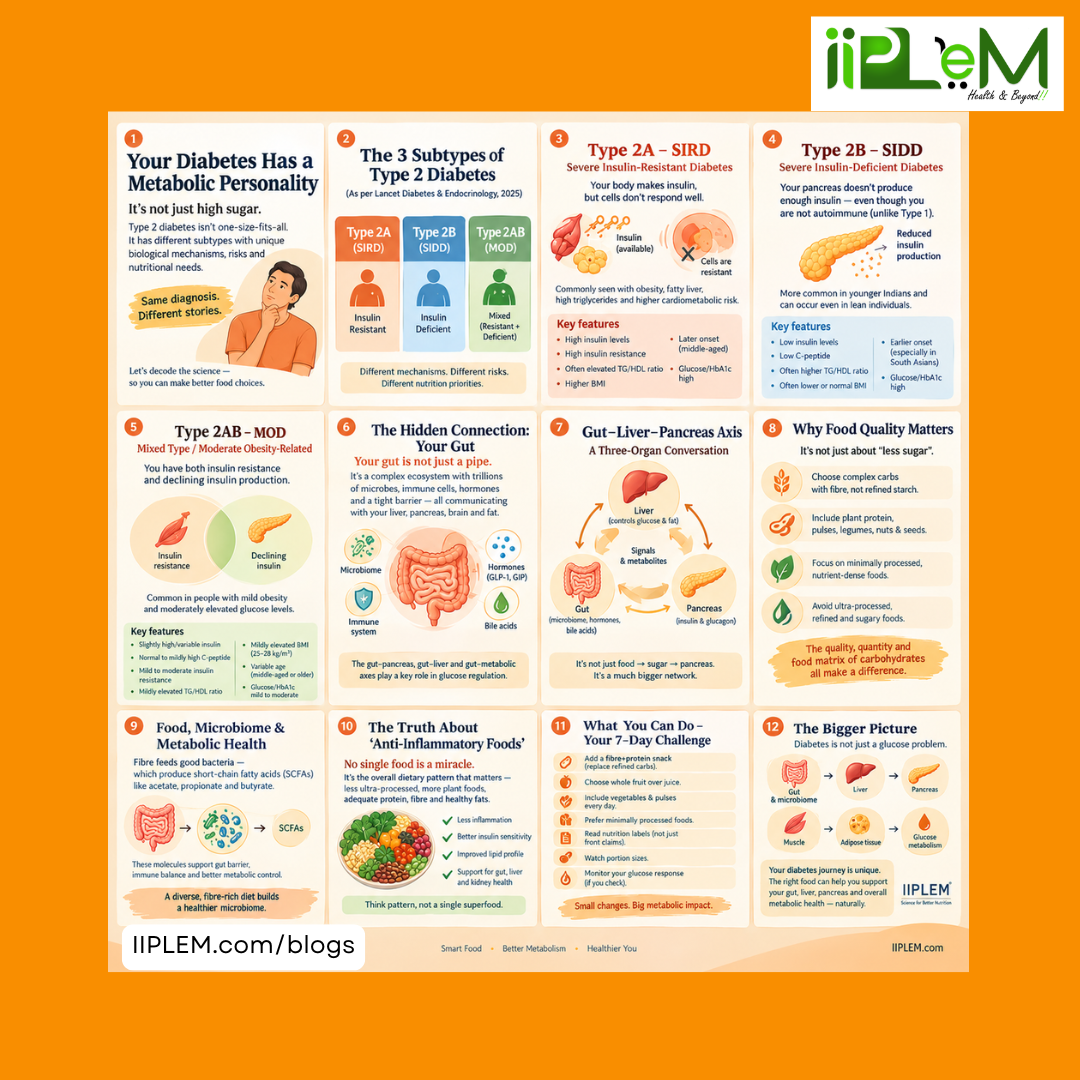
The emerging framework broadly describes three non-autoimmune phenotypes.
Type 2A — Severe Insulin-Resistant Diabetes (SIRD)
Here, the pancreas may still produce considerable insulin, sometimes a lot of it.
The problem is that the body's tissues do not respond adequately to that insulin.
Think of insulin as a key.
In this phenotype, there may be plenty of keys—but the locks have become resistant.
This pattern is commonly associated with:
• pronounced insulin resistance
• higher insulin levels
• obesity or excess adiposity
• elevated triglycerides
• fatty liver/metabolic dysfunction-associated steatotic liver disease
• increased cardiometabolic risk
This is where simply saying “your sugar is high” misses much of the biology.
The underlying metabolic environment matters.
________________________________________
Type 2B — Severe Insulin-Deficient Diabetes (SIDD)
This is almost the opposite problem.
The body does not produce enough insulin to adequately control blood glucose.
This can occur without the autoimmune destruction characteristic of Type 1 diabetes or LADA.
And this phenotype is especially important in the Indian context.
Research in Indian populations has found a substantial representation of insulin-deficient diabetes, particularly among people with younger-onset Type 2 diabetes. In one Indian cohort, SIDD was the predominant subgroup. (PubMed)
That leads to a clinically important lesson:
A relatively lean person with Type 2 Diabetes should not automatically be assumed to have “mild diabetes.”
Their glucose may be high because their pancreas is struggling to produce sufficient insulin—not because they simply “ate too much.”
________________________________________
Type 2AB — The Mixed Phenotype
Many people will not fit neatly into either box.
They may have both insulin resistance and declining insulin secretion, with intermediate metabolic characteristics.
This is important because real human biology rarely respects neat categories.
Two people with identical HbA1c values can have very different metabolic problems underneath.
And that means their nutritional priorities may not be identical either.
________________________________________
The diabetes organ you don't hear enough about: the gut
Here is where the conversation becomes much more interesting.
Your intestine is not merely a pipe through which food passes.
It contains:
• trillions of microorganisms
• enteroendocrine cells
• immune cells
• bile-acid signalling systems
• a highly active intestinal barrier
• nerves and metabolic signalling pathways
Together, these systems communicate with the pancreas, liver, adipose tissue and brain.
Researchers increasingly describe these interactions as interconnected gut–pancreas, gut–liver and gut–metabolic axes. (PubMed)
This does not mean that “bad gut bacteria cause diabetes.”
That would be an oversimplification.
Rather, diet, medications, obesity, metabolic status and other factors can influence the intestinal ecosystem; in turn, microbial metabolites and intestinal signals may influence glucose and lipid metabolism.
________________________________________
The Gut–Liver–Pancreas Axis: the missing triangle in diabetes nutrition
Consider what happens after a meal.
Food enters the intestine.
The gut detects nutrients and communicates with the pancreas through hormones such as GLP-1 and GIP.
Meanwhile, microbial fermentation of dietary fibre produces metabolites such as short-chain fatty acids (SCFAs).
Bile acids produced by the liver travel into the intestine and are themselves modified by gut microorganisms. Some bile-acid signals subsequently influence metabolic pathways through receptors such as FXR and TGR5. (PubMed)
At the same time, the liver determines how much glucose and fat are stored, released or processed.
So glucose regulation is not simply:
Food → blood sugar → pancreas.
It is closer to:
Food → Gut → Microbiome → Hormonal & microbial signals → Liver + Pancreas → Whole-body metabolism
This is one reason diabetes nutrition deserves considerably more sophistication than simply counting teaspoons of sugar.
________________________________________
Fibre is not merely “roughage”
This is one of the most underappreciated ideas in diabetes nutrition.
When you eat fibre-rich plant foods, some fibres escape digestion in the small intestine and reach the colon.
There, selected microorganisms can ferment them.
One consequence is production of short-chain fatty acids such as acetate, propionate and butyrate.
These molecules are not simply waste products.
They can act as signalling molecules affecting intestinal physiology, immune pathways and metabolic regulation.
Dietary fibre is therefore one of the nutritional levers capable of influencing the diet–microbiome–metabolism connection. (PubMed)
This does not mean:
“Eat fibre and your diabetes will disappear.”
It means something more scientifically useful:
The quality of the carbohydrate matters—not merely the quantity.
________________________________________
“Low sugar” is not the same as metabolically intelligent food
This is where many diabetes diets go wrong.
A food can be:
low in added sugar but highly refined.
It can also be:
gluten-free but low in fibre and rapidly digestible.
And it can be:
plant-based but still nutritionally poor if built around refined starches, sugar or excessive calories.
Therefore, GFCFSF—gluten-free, casein-free, soy-free—is not automatically a diabetes-friendly nutritional strategy.
Nor is “plant-based” automatically synonymous with healthy.
The better question is:
What does the entire nutritional architecture of the food look like?
Consider:
• total carbohydrate
• available carbohydrate
• fibre
• protein quality
• fat quality
• degree of processing
• portion size
• micronutrient density
• palatability and adherence
• individual glucose response
This is where nutrition science becomes more useful than social-media food labels.
________________________________________
What should an Indian person with diabetes actually do?
1. Stop thinking only about sugar. Start thinking about food structure.
Instead of asking:
“Is this sugar-free?”
ask:
“What happens to my glucose, satiety and overall metabolic load after I eat this?”
________________________________________
2. Build meals around minimally processed plant foods
Regularly include combinations of:
• vegetables
• pulses and legumes
• appropriate whole grains or other high-fibre carbohydrate sources
• nuts and seeds
• whole fruits rather than fruit juice
• appropriate plant proteins
ICMR guidance has long emphasized whole grains, pulses, vegetables and adequate dietary fibre in diabetes nutrition. (Indian Council of Medical Research)
The ADA's current standards similarly emphasize non-starchy vegetables, whole fruits, legumes, whole grains, nuts and seeds while limiting refined grains, sugar-sweetened beverages and highly processed foods. (Diabetes Journals)
________________________________________
3. Don't fear carbohydrates—manage their quality, quantity and context
Carbohydrates are not automatically the enemy.
The difference between eating a fibre-rich pulse-and-vegetable meal and consuming a highly refined starch-based snack can be enormous.
For many people, food matrix, fibre, protein, fat, portion size and processing can influence the glucose response.
________________________________________
4. Think about your liver, not only your pancreas
Insulin resistance and metabolic dysfunction in the liver are deeply connected with Type 2 Diabetes.
The gut–liver axis is now an active area of diabetes and metabolic-disease research, particularly in relation to fatty liver/MASLD, bile acids, inflammation and insulin resistance. (PubMed)
So if you have Type 2 Diabetes, ask your doctor whether your overall metabolic assessment should include appropriate evaluation of:
weight/waist → lipids → liver health → kidney health → glucose control
rather than looking at HbA1c in isolation.
________________________________________
5. Feed your microbiome—but don't fall for “miracle probiotic” marketing
A healthy gut microbiome is not created by one capsule, one fermented food or one “detox” drink.
The microbiome responds to the overall dietary environment.
A consistently diverse, fibre-containing diet may provide the substrates that support beneficial microbial functions and SCFA production. (PubMed)
In other words:
Your microbiome doesn't need a miracle food. It needs a better food environment.
________________________________________
And here is the important catch about “anti-inflammatory foods”
The phrase “anti-inflammatory food” is increasingly popular online.
But it can become misleading.
No individual food should be promoted as a treatment for diabetes simply because it contains an antioxidant, polyphenol or other bioactive compound.
A more defensible scientific approach is to build a dietary pattern that reduces excessive intake of highly refined, energy-dense and nutritionally poor foods while increasing nutrient-dense, fibre-rich plant foods and appropriate protein sources.
That is a dietary pattern—not a magic ingredient.
________________________________________
Where GFCFSF foods can fit
For people who need or prefer gluten-free, casein-free and soy-free foods, the challenge is not merely removing ingredients.
It is replacing them intelligently.
A nutritionally designed GFCFSF food should ideally contribute something meaningful to the diet—such as appropriate protein, fibre or micronutrient density—rather than simply replacing wheat, dairy or soy with refined starch.
That distinction is particularly important for people managing metabolic health.
“Free-from” should not mean “nutrition-free.”
This is an area where food formulation has enormous potential: designing convenient foods around protein quality, fibre, digestibility, carbohydrate quality and overall nutrient density, rather than simply removing a list of ingredients.
That is a much more scientifically meaningful direction for the next generation of diabetes-friendly foods.
________________________________________
Can your diabetes subtype change what you should focus on?
Potentially—but don't self-classify yourself.
The emerging subtype framework is valuable because it reminds us that insulin resistance and insulin deficiency are different biological problems.
But subtype classification is not yet a simple home test.
HbA1c, fasting glucose, body composition, C-peptide, lipid profile, kidney function, liver status and other clinical variables need to be interpreted together by a qualified healthcare professional. Importantly, the 2025 framework itself notes that subtype assignment does not necessarily outperform routinely available clinical measures for predicting every outcome. (PubMed Central (PMC))
So don't ask:
“Am I Type 2A or Type 2B?”
Ask your doctor a better question:
“What appears to be driving my diabetes—insulin resistance, insulin deficiency, or both?”
That question can lead to a much more meaningful conversation.
________________________________________
Your practical 7-day challenge
For the next week:
✓ Replace one refined carbohydrate-heavy snack with a fibre- and protein-containing option.
✓ Choose whole fruit instead of fruit juice.
✓ Add vegetables and pulses to your main meals.
✓ Prefer minimally processed foods over ultra-processed alternatives.
✓ Read the nutrition panel—not just the front-of-pack claims.
✓ Pay attention to portion size even when a food is marketed as “healthy.”
✓ If you monitor glucose, observe your response to meals rather than judging foods purely by reputation.
And don't stop or change prescribed diabetes medicines because of dietary changes without discussing it with your clinician.
________________________________________
The bigger idea: diabetes is not just a glucose problem
The future of diabetes nutrition is unlikely to be about finding one “diabetic superfood.”
It is more likely to be about understanding the interaction between:
Food → microbiome → gut signalling → liver → pancreas → muscle → adipose tissue → glucose metabolism
And eventually, nutrition may become increasingly personalized around the biology driving an individual's diabetes.
That is why two people with the same HbA1c may not necessarily benefit from exactly the same nutritional strategy.
The next generation of diabetes nutrition will not simply ask, “How much sugar is in this food?”
It will ask:
- What is this food made of?
- How is it processed?
- How much fibre does it provide?
- What is its protein quality?
- What metabolic response does it generate?
- And what does it contribute to the ecosystem of the gut?
That is a much bigger—and much more scientifically interesting—question.
 ________________________________________
IIPLEM's Perspective
At IIPLEM, we believe the future of nutrition lies at the intersection of food science, metabolic physiology and microbiome biology.
The opportunity is not to list/make another “diabetic food.”
It is to scout trustable foods whose scientifically-backed formulation itself is informed by human metabolism—with attention to carbohydrate quality, protein, fibre, food matrix, ingredient selection and real-world dietary behaviour.
Because the goal should not be to create foods that people with diabetes have to tolerate.
The goal should be to create nutritionally intelligent foods that people can genuinely enjoy as part of a better dietary pattern.
------------
Scientific References
Selected peer-reviewed literature and clinical guidance informing this article.
- Jagannathan R, Staimez LR, Narayan KMV. Type 2 diabetes subtypes classification: a global reckoning with heterogeneity. The Lancet Diabetes & Endocrinology. 2025;13(11):903–905. doi:10.1016/S2213-8587(25)00256-6. PMID: 40953573. (PubMed)
- Yajnik CS, Wagh R, Kunte P, et al. Polygenic scores of diabetes-related traits in subgroups of type 2 diabetes in India: a cohort study. The Lancet Regional Health – Southeast Asia. 2023. doi:10.1016/j.lansea.2023.100182. PMID: 37492423. (PubMed)
- Anjana RM, Baskar V, Nair ATN, et al. Novel subgroups of type 2 diabetes and their association with microvascular outcomes in an Asian Indian population: a data-driven cluster analysis: the INSPIRED study. BMJ Open Diabetes Research & Care. 2020;8:e001506.
This is particularly useful for the Indian context and the relationship between diabetes subgroups and complications. (PubMed) - Salamone D, Rivellese AA, Vetrani C. The relationship between gut microbiota, short-chain fatty acids and type 2 diabetes mellitus: the possible role of dietary fibre. Acta Diabetologica. 2021;58(9):1131–1138. doi:10.1007/s00592-021-01727-5. PMID: 33970303. (PubMed)
- Nogal A, Valdes AM, Menni C. The role of short-chain fatty acids in the interplay between gut microbiota and diet in cardio-metabolic health. Gut Microbes. 2021;13(1):1–24. doi:10.1080/19490976.2021.1897212. PMID: 33764858. (PubMed)
- Gut–Liver–Pancreas Axis Crosstalk in Health and Disease: From the Role of Microbial Metabolites to Innovative Microbiota Manipulating Strategies. Nutrients/related peer-reviewed literature, 2024. PMID: 39061972.
Useful for the article's discussion of microbial metabolites, SCFAs, bile acids, GLP-1 and gut–liver–pancreas communication. (PubMed) - American Diabetes Association Professional Practice Committee. Facilitating Positive Health Behaviors and Well-being to Improve Health Outcomes: Standards of Care in Diabetes—2026. Diabetes Care. 2026;49(Suppl 1).
Supports the recommendations regarding minimally processed, nutrient-dense, high-fibre carbohydrates; vegetables; legumes; whole fruits; nuts/seeds; and minimizing refined/ultra-processed foods. (Diabetes Journals) - Indian Council of Medical Research (ICMR). Guidelines for Management of Type 2 Diabetes 2018.
Relevant to the Indian dietary context, including whole grains, pulses, vegetables, fruits, fibre and protein. (Indian Council of Medical Research) - Food Safety and Standards Authority of India (FSSAI). Food Safety and Standards (Advertising and Claims) Regulations, 2018, as amended.
Relevant to responsible communication of nutrition/health claims and avoiding disease-treatment claims for foods. (FSSAI) - American Diabetes Association Professional Practice Committee. Facilitating Positive Health Behaviors and Well-being to Improve Health Outcomes: Standards of Care in Diabetes—2025. Diabetes Care. 2025;48(Suppl 1). Supports individualized nutrition, dietary-pattern approaches and emphasis on whole foods, legumes, whole grains, vegetables, nuts/seeds and minimizing refined/ultra-processed foods. (Diabetes Journals)
________________________________________
Medical & regulatory note
This article is intended for nutrition education and general awareness, not for diagnosis, treatment or replacement of individualized medical advice. Diabetes medicines should not be stopped or modified without medical supervision.
For food marketing in India, disease-treatment or disease-cure claims should not be attached to ordinary foods unless specifically permitted. FSSAI's advertising and claims framework permits specified nutrition/health claims subject to conditions, while food businesses should not imply that a food treats, cures, mitigates or prevents a disease without the applicable regulatory basis. (FSSAI)
-----
Will soon add peer-reviewed comments in this section
-----------
#Type2Diabetes #DiabetesIndia #DiabetesNutrition #MetabolicHealth #GutMicrobiome #GutLiverAxis #GutPancreasAxis #InsulinResistance #InsulinDeficiency #PersonalizedNutrition #PrecisionNutrition #FoodScience #NutritionScience #EvidenceBasedNutrition #IndianNutritio
About the Author
Ft. Arnab Guha — Senior Food Scientist, Inventor & Founder, Impeccable Innovations Pvt. Ltd.
Arnab Guha is a food scientist and innovation entrepreneur with 20+ years of experience spanning food, agriculture and biotechnology, including corporate R&D and manufacturing. He writes on nutrition, gut health, food science, emerging health technologies and science-led innovation. With a M.Sc. degree in Food Science & Technology from CCS HAU-Hisar (2006), plus a B.A.Sc. Food Technology degree from BCAS Delhi University (2004) and inventorship on 6 patents, Arnab founded Impeccable Innovations Pvt Ltd (IIPL) in 2016 to build science-backed, gut-friendly innovative healthy & non-inflammatory food company. In his entrepreneurship journey, he has also founded an ethical health-first marketplace (IIPLeM.com) & co-founded NGO named - 2nd Brain Foundation).
SUBSCRIBE TO OUR YOUTUBE CHANNEL FOR LATEST VIDEOS ON GUT-NUTRITION & HEALTH RELATED CONTENTS