Real Food Is Everyone’s Business: A Call to Action This World Food Day 2026
Doctors, dietitians, food scientists, CEOs, marketers, farmers, governments and families must work together to build a healthier food system.
Campaign message: Real Food. Better Food Systems. Healthier Futures.
Follow our Instagram: https://www.instagram.com/p/DejawGgEo7K/
-----------
Introduction: Who is responsible for what we eat?
Food is much more than a source of calories. It supplies the energy, protein, essential fats, vitamins, minerals and dietary fibre our bodies need to function. Our everyday food choices also influence the nutritional quality of our diets and, over time, our risk of diet-related diseases.
Yet the food environment in which these choices are made is shaped by much more than individual willpower.
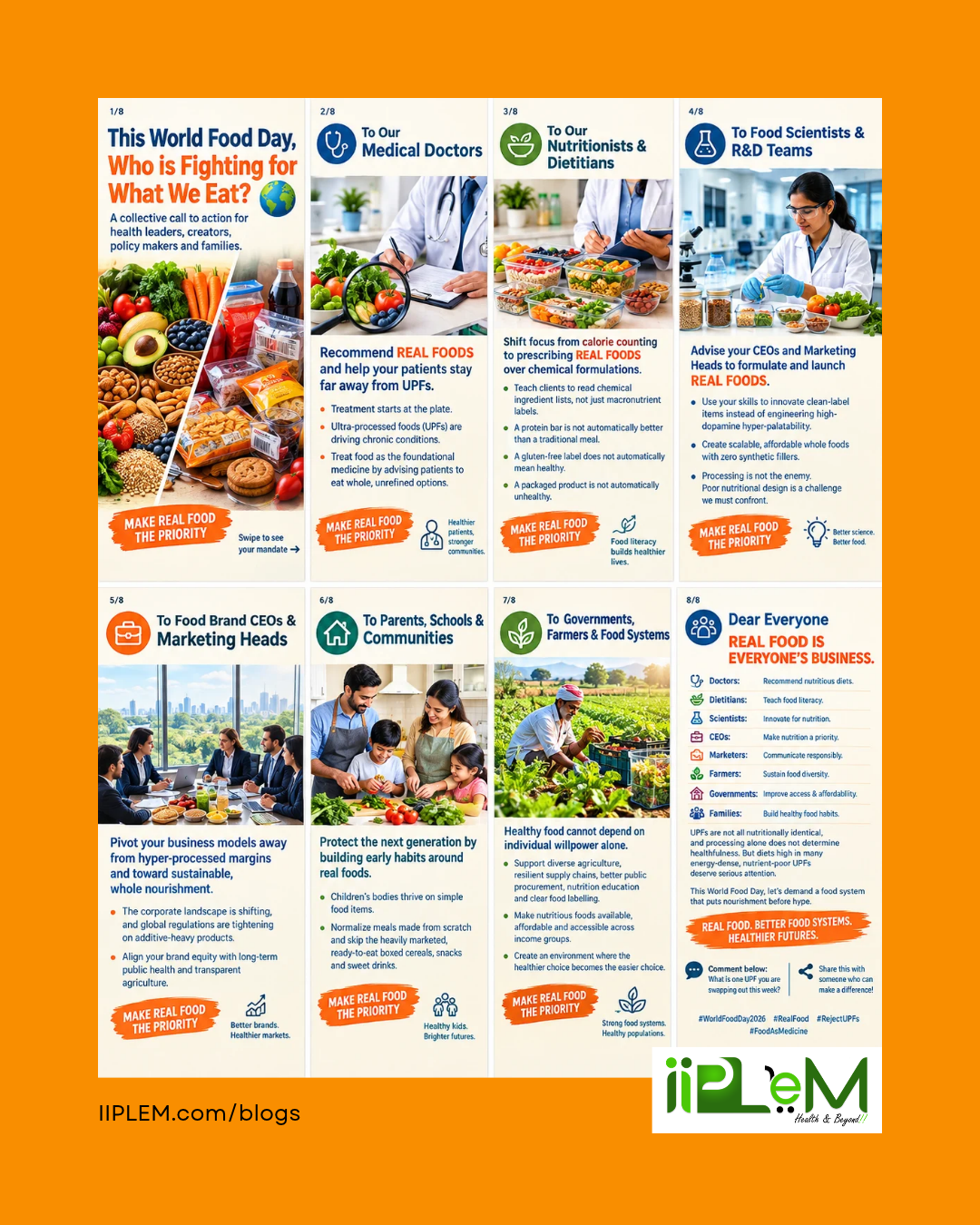
Doctors influence dietary advice. Dietitians translate nutritional science into practical eating patterns. Food scientists develop products and manufacturing technologies. CEOs determine business priorities and resource allocation. Marketing teams influence consumer perceptions. Farmers shape the diversity of agricultural production. Governments establish the policies that influence food availability, affordability, labelling and public procurement. Families and communities help establish lifelong eating habits.
Every one of these stakeholders influences what reaches our plates.
That is why, this World Food Day 2026, we need a collective conversation that goes beyond telling people to eat better.
We must ask a more fundamental question: Are our healthcare systems, food businesses and public policies making nutritious food easier to choose?
At IIPLEM, our message is simple:
REAL FOOD IS EVERYONE’S BUSINESS.
1. Why the conversation about real food matters
A nutritious dietary pattern generally emphasises variety, adequacy, balance and moderation. It includes appropriate amounts of vegetables, fruits, pulses, whole grains, nuts, seeds and suitable sources of protein, while limiting excessive intake of free sugars, sodium and unhealthy fats. Individual needs vary with age, activity, health status, culture and access to food.
The World Health Organization recommends diverse diets built around nutritious foods, including whole grains, vegetables, fruits and pulses. It also highlights dietary fibre and limits on free sugars and other dietary components that can adversely affect health. https://www.who.int/news-room/fact-sheets/detail/healthy-diet
In India, this conversation has particular relevance. Traditional dietary patterns offer an enormous diversity of millets, rice, pulses, vegetables, fruits, nuts, seeds and fermented foods. These foods can provide a strong foundation for nutritious diets when selected, prepared and combined appropriately.
However, traditional foods are not automatically nutritionally complete, and modern products are not automatically unhealthy. A diet based on a narrow range of foods may lack essential nutrients even if those foods are minimally processed. Conversely, some packaged or fortified foods can improve nutritional adequacy, safety, convenience and accessibility.
The goal should not be to romanticise the past or reject technology.
The goal should be to use food science, agriculture, public health and responsible commerce to improve the quality of the food supply.
2. Ultra-processed foods: Why the science deserves attention
Ultra-processed foods, commonly abbreviated as UPFs, are frequently discussed in public health debates. The NOVA classification system groups foods according to the nature, extent and purpose of processing.
Many products commonly classified as UPFs include packaged sweet snacks, sugary drinks, confectionery, instant meals and certain ready-to-eat products. However, the category is broad and contains products with different nutritional profiles.
This distinction matters.
A food's healthfulness cannot be determined by processing level alone. Its overall nutritional composition, ingredients, portion size, consumption frequency and role within the broader dietary pattern all matter.
What does the evidence tell us?
A 2024 umbrella review published in The BMJ examined meta-analyses covering nearly 9.9 million participants. It found that greater exposure to UPFs was associated with a range of adverse health outcomes. The strength and certainty of evidence varied by outcome, and much of the underlying evidence was observational. These findings support concern about diets high in many UPFs, but they do not establish that every UPF causes disease or that all products in this category carry equal risk.
Reference: Lane MM et al. Ultra-processed food exposure and adverse health outcomes: umbrella review of epidemiological meta-analyses. BMJ. 2024;384. https://www.bmj.com/content/384/bmj-2023-077310
Several questions remain important for researchers:
-
How much of the observed association is attributable to the products themselves, and how much reflects the overall dietary pattern?
-
What roles do energy density, fibre content, nutrient composition, food structure, eating rate and palatability play?
-
How do affordability, time constraints, marketing and food access influence consumption?
-
Which product categories are most concerning, and which may offer useful nutritional benefits?
These questions require continued investigation rather than simplistic conclusions.
What should consumers and the food industry do now?
A practical response is to increase the availability and consumption of diverse, nutritious foods while reducing reliance on products that contribute substantial amounts of free sugars, sodium, unhealthy fats or excess energy without adequate nutritional value.
We should also recognise that convenience, shelf life, food safety, fortification and affordability are legitimate food-system needs.
The objective is not to eliminate all processing. It is to make nutritional quality a central criterion in food design, purchasing and public health.

3. Dear medical doctors: Recommend nutritious dietary patterns
Medical doctors regularly help patients manage conditions in which nutrition can play an important role, including type 2 diabetes, cardiovascular disease and certain gastrointestinal disorders.
However, dietary counselling can sometimes receive less attention than medication, investigations and other clinical priorities.
Doctors can help change this by asking patients about their usual food intake and discussing practical dietary improvements as part of appropriate preventive and clinical care.
For example, where suitable for the individual, doctors can encourage patients to:
-
Eat a greater variety of vegetables, fruits, pulses and whole grains.
-
Choose appropriate sources of protein and unsaturated fats.
-
Reduce excessive consumption of sugary drinks and nutrient-poor snack foods.
-
Consider fibre intake, overall dietary quality and portion sizes.
-
Seek advice from a qualified dietitian when more detailed nutritional planning is needed.
Dietary recommendations must be individualised. People with kidney disease, food allergies, coeliac disease, malnutrition or other specific conditions may require tailored advice.
Food should complement evidence-based medical care, not replace necessary medication or treatment.
Our appeal to doctors: Make nutrition a meaningful part of the clinical conversation. Ask not only what your patients take as medicine, but also what their everyday diets look like.
4. Dear nutritionists and dietitians: Teach food literacy
Nutrition professionals play a crucial role in translating scientific evidence into achievable eating habits.
Their work should extend beyond calorie calculations, macronutrient targets and restrictive meal plans. Patients also need to understand food quality, dietary diversity, ingredient lists, preparation methods and the difference between marketing claims and meaningful nutritional value.
For example:
-
A high-protein claim does not automatically make a product a balanced food.
-
Gluten-free does not automatically mean healthier or more nutritious.
-
Sugar-free does not necessarily mean low in calories or beneficial in every context.
-
A long ingredient list does not automatically mean a product is harmful.
-
A packaged product is not automatically inferior to a home-prepared meal.
Food literacy helps people make informed decisions without fear or confusion.
Nutrition professionals can also encourage culturally relevant, affordable dietary patterns rather than assuming that everyone has access to expensive specialty foods, elaborate meal preparation or imported ingredients.
Our appeal to nutritionists and dietitians: Help people understand not just how much they eat, but also what they eat, why it matters and how to make better choices sustainably.
5. Dear food scientists and R&D teams: Innovate for nutrition
Food scientists occupy a unique position at the intersection of nutrition, food safety, technology, consumer behaviour and commercial manufacturing.
Their decisions can influence the composition, texture, flavour, stability, shelf life, cost and accessibility of foods consumed by large populations.
This creates an opportunity to redefine food innovation.
Innovation should not be judged only by novelty, production efficiency, consumer appeal or sales potential. It should also be evaluated by the nutritional and practical value delivered to consumers.
Food scientists can contribute by:
Improving nutritional composition. Reduce excessive added sugars, sodium and unhealthy fats where technically and sensorially feasible. Increase dietary fibre or appropriate protein content when it improves the product's nutritional value.
Developing better everyday staples. Explore nutritious formulations using pulses, whole grains, millets, seeds and other suitable ingredients.
Making nutrition affordable. A product that delivers excellent nutrition but remains inaccessible to most consumers has limited population-level impact.
Preserving food safety and quality. Appropriate processing can reduce hazards, extend shelf life, improve digestibility and make foods safer and more convenient.
Applying rigorous validation. Evaluate nutritional composition, sensory acceptability, stability, safety and performance under real-world storage and use conditions.
Communicating evidence honestly. Ensure that product claims are supported by appropriate evidence and comply with applicable regulations.
Food scientists should not be asked to abandon processing technology. They should be empowered to apply it responsibly.
The central question for every R&D team is:
Can we make this product more nutritious, affordable, safe and useful without compromising the qualities consumers genuinely need?
Our appeal to food scientists: Advise your CEOs and Marketing Heads to make nutritional improvement a measurable part of the innovation agenda.
6. Dear CEOs and business leaders: Make nutrition a business priority
Food companies operate in competitive markets. They must manage costs, manufacturing efficiency, consumer expectations, regulatory requirements and profitability.
But food is not an ordinary consumer product. Its nutritional quality can affect the health of the people who consume it regularly.
Business leadership therefore has an opportunity—and a responsibility—to consider the wider consequences of product portfolios.
CEOs can begin by asking:
-
What proportion of our portfolio provides meaningful nutritional value?
-
Are we investing sufficiently in healthier formulations and nutritious everyday foods?
-
Are our product-development incentives aligned with responsible nutritional goals?
-
Can we improve affordability without compromising safety or quality?
-
Are our nutrition and health claims accurate, substantiated and transparent?
-
Do we market products responsibly, particularly to children?
-
Do we measure nutritional improvement alongside revenue and market share?
These questions need not create a conflict between commercial performance and public health.
Well-designed products that meet genuine consumer needs can create business opportunities through trust, differentiation, repeat purchasing and responsible innovation. Commercial success, however, is not guaranteed simply because a product is marketed as healthy; consumer acceptance, affordability, evidence and execution remain essential.
Our appeal to food industry leaders: Make nutrition a strategic business objective, not merely a marketing theme.
7. Dear marketing teams: Communicate responsibly
Marketing has enormous power to shape perceptions of food.
Words such as natural, high protein, multigrain, clean label, sugar-free and healthy can influence consumer choices. But a claim about one characteristic does not necessarily establish the overall healthfulness of a product.
Responsible marketing begins with an important principle: consumers deserve information that is accurate, understandable and not misleading.
Marketing teams should:
-
Present nutrition information clearly and transparently.
-
Avoid exaggerating the health benefits of individual ingredients.
-
Ensure that health and nutrition claims have appropriate substantiation.
-
Avoid implying that a food can prevent or treat a disease without legally permissible, scientifically supported grounds.
-
Take particular care when communicating with children and other vulnerable audiences.
-
Avoid creating unnecessary fear around ingredients or food-processing technologies.
Food brands can make nutritious products appealing without making exaggerated promises.
Our appeal to marketers: Sell the genuine value of food. Do not sell a health halo that the product cannot substantiate.
8. Dear farmers and agricultural communities: Sustain food diversity
A healthy food system begins long before a product reaches a supermarket shelf.
Farmers influence which crops are cultivated, the varieties available, the quality of raw materials and the resilience of agricultural supply chains.
Agricultural diversity can support diverse diets, preserve valuable food traditions and improve resilience to certain environmental and market risks. The practical benefits depend on local conditions, agricultural practices, infrastructure and economic viability.
Supporting food diversity means:
-
Strengthening the availability of pulses, millets, whole grains, fruits and vegetables.
-
Supporting appropriate crop diversity and locally suitable agricultural practices.
-
Improving storage, transport and market access to reduce avoidable food loss.
-
Strengthening links between farmers, processors, retailers and institutional food services.
-
Encouraging responsible sourcing and transparent supply chains.
Farmers should not be expected to carry this responsibility alone. They need viable markets, fair opportunities, appropriate infrastructure and supportive policies.
Our appeal to agricultural communities and food businesses: Build supply chains that reward nutritious diversity and make quality raw materials more accessible.
9. Dear governments and policymakers: Make healthy food accessible
Public health messaging often tells people to make better food choices. Yet those choices are shaped by household income, local availability, food prices, working hours, infrastructure, education and the food environment.
A nutritious diet cannot become a realistic daily choice if appropriate foods are unavailable or unaffordable.
Governments can help create more supportive food environments through:
-
Nutrition education grounded in credible scientific evidence.
-
Clear, accessible food labelling and appropriate regulation of nutrition and health claims.
-
Strong food safety standards and effective enforcement.
-
Nutrition-sensitive public procurement for schools, hospitals and other public institutions.
-
Policies that improve access to diverse, nutritious foods.
-
Support for agricultural diversity, food storage and efficient distribution.
-
Responsible approaches to marketing foods to children.
-
Research and surveillance to assess dietary patterns and public health outcomes.
Policy measures should be proportionate, evidence-informed and evaluated for their effects on health, affordability, access and livelihoods.
The objective should not be to make nutritious eating the privilege of a particular income group. It should be to create conditions in which a nutritious diet is practical for more people.
Our appeal to governments: Build food environments that make the healthier choice the easier and more affordable choice.
10. Dear parents, schools and communities: Build healthy food habits
Families and communities influence how children learn about food, develop preferences and establish eating routines.
Children benefit when nutritious foods are familiar, accessible and enjoyable. Involving them in age-appropriate food preparation, offering variety and modelling balanced eating can help develop positive habits.
Schools can reinforce these practices through nutrition education, supportive meal programmes and responsible food environments.
But the message must remain compassionate.
Parents often balance limited time, financial pressures, work commitments and the availability of convenient foods. Advising families to prepare everything from scratch is not always realistic.
Instead, practical steps can include:
-
Adding vegetables or pulses to familiar meals.
-
Offering whole fruits more often.
-
Using convenient frozen or appropriately preserved foods when useful.
-
Choosing less sugary drinks more frequently.
-
Making water readily available.
-
Including diverse grains and protein sources across the week.
-
Helping children understand food labels and advertising.
Healthy habits should be built through encouragement and access—not shame or unrealistic expectations.
Our appeal to families and communities: Make nutritious food part of everyday life, one practical choice at a time.
11. The food system must change—not just the consumer
One of the most important lessons from nutrition science and public health is that individual behaviour does not exist in isolation.
A person may understand the importance of a nutritious diet and still struggle to follow one because of cost, convenience, time constraints or limited access to suitable foods.
Similarly, doctors cannot compensate for every weakness in the food environment. Nutrition professionals cannot educate their way out of every affordability barrier. Food scientists cannot improve products without suitable business priorities and investment. Farmers cannot diversify supply without viable demand and infrastructure.
This is why coordinated action matters.
| Stakeholder | Priority action |
|---|---|
| Medical doctors | Integrate appropriate nutrition advice into clinical care. |
| Dietitians | Build food literacy and support sustainable eating patterns. |
| Food scientists | Design and validate nutritionally improved products. |
| CEOs | Make nutrition part of portfolio strategy and performance measures. |
| Marketers | Communicate accurately and avoid misleading health impressions. |
| Farmers | Support diverse, resilient and nutritious food supply chains. |
| Governments | Improve food safety, access, affordability and accountability. |
| Families and schools | Build positive food habits and supportive environments. |
| Consumers | Ask informed questions and support nutritious options where practical. |
No single stakeholder can solve every problem. But every stakeholder can contribute to measurable progress.
12. What should we demand from the food industry?
A credible campaign for real food should move beyond slogans and encourage specific improvements.
We should ask food companies to report meaningful progress in areas such as:
-
Nutritional quality: Changes in added sugars, sodium, unhealthy fats, fibre and other relevant nutritional measures.
-
Product diversity: Investment in nutritious everyday foods that meet different dietary needs and preferences.
-
Affordability: Efforts to make nutritionally improved products accessible to a wider range of consumers.
-
Responsible marketing: Accurate claims and transparent consumer communication.
-
Food safety: Consistent quality control, validated processes and appropriate shelf-life management.
-
Evidence and accountability: Clear criteria for product improvement and credible reporting of progress.
Targets should be appropriate to the company's products and transparently measured. A single headline metric cannot capture the nutritional quality of an entire portfolio.
The food industry can contribute to better public health when nutritional value becomes a genuine design and business consideration.
13. What does REAL FOOD mean in practice?
The phrase real food is useful as a public-facing reminder to prioritise nourishing, recognisable and diverse foods. However, it is not a formal scientific or regulatory category with one universally accepted definition.
For this campaign, we use it to encourage dietary patterns that include a broad variety of nutritious foods and do not rely excessively on energy-dense, nutrient-poor products.
Examples include:
-
Vegetables and fruits.
-
Pulses, beans and lentils.
-
Whole grains and suitable traditional staples.
-
Nuts and seeds.
-
Appropriate sources of protein.
-
Nutritious home-prepared or commercially prepared meals.
-
Convenient foods that meet relevant nutritional, safety and dietary requirements.
The emphasis is on overall dietary quality rather than a simplistic distinction between homemade and packaged food.
Food processing can preserve food, improve safety, reduce waste, provide convenience and enable fortification. Some packaged foods can be valuable components of a nutritious diet.
Likewise, a home-prepared meal can still be nutritionally unbalanced if it relies heavily on excess salt, added sugar or unhealthy fats.
The better question is not simply, “Was this food processed?” It is, “What does this food contribute to the overall diet, and how often are we eating it?”
14. A collective commitment for World Food Day 2026
This World Food Day, let us move from awareness to action.
Let doctors make nutrition a meaningful part of care.
Let dietitians teach food literacy.
Let food scientists innovate for better nutritional quality.
Let CEOs make nutrition a business priority.
Let marketers communicate responsibly.
Let farmers sustain food diversity.
Let governments improve access and affordability.
Let families, schools and communities build healthy food habits.
And let consumers demand more than attractive packaging and persuasive claims.
The measure of progress should not be how often we talk about healthy food. It should be whether nutritious choices become more accessible, affordable, appealing and practical in everyday life.
This is not a call to reject all modern foods or to treat every processed product as harmful. It is a call to make nutritional quality, food safety, scientific integrity and public health central to the decisions that shape our food supply.
Conclusion: Real food is everyone’s business
Food connects agriculture, science, healthcare, industry, commerce, culture and everyday life.
The responsibility for a healthier food environment must therefore be shared across the entire food system.
We need better nutrition education, responsible product innovation, transparent marketing, diverse agricultural supply chains, evidence-informed policies and realistic support for families.
Above all, we need to recognise that food is too important to be shaped by commercial considerations alone.
This World Food Day 2026, let us put nourishment before hype and turn our shared responsibility into meaningful action.
🍎 REAL FOOD. BETTER FOOD SYSTEMS. HEALTHIER FUTURES.
Join the conversation
Which stakeholder has the greatest opportunity to improve the food environment—and what specific action should they take first?
Share your perspective, discuss the evidence and pass this message to someone who can influence how food is produced, recommended, developed, marketed or accessed.
IIPLEM.com | Science-led food innovation. Nutrition-focused thinking. Responsible food systems.
This article discusses why every stakeholder in food ecosystem should crave for real foods.
-----
Ft. Arnab Guha — Food Scientist, Inventor & Founder, Impeccable Innovations Pvt. Ltd.
Arnab Guha is a food scientist and innovation entrepreneur with 20+ years of experience spanning food, agriculture and biotechnology, including corporate R&D and manufacturing. He writes on nutrition, gut health, food science, emerging health technologies and science-led innovation. With a M.Sc. degree in Food Science & Technology from CCS HAU-Hisar (2006), plus a B.A.Sc. Food Technology degree from BCAS Delhi University (2004) and inventorship on 6 patents, Arnab founded Impeccable Innovations Pvt Ltd (IIPL) in 2016 to build science-backed, gut-friendly innovative healthy & non-inflammatory food company. In his entrepreneurship journey, he has also founded an ethical health-first marketplace (IIPLeM.com) & co-founded NGO named - 2nd Brain Foundation).
SUBSCRIBE TO OUR YOUTUBE CHANNEL FOR LATEST VIDEOS ON GUT-NUTRITION & HEALTH RELATED CONTENTS